Labels & Primitives
Eight primitives. One operator. A spec that doesn't move.
LaP is a tiny language with a frozen spec. A .lap file written today should still compile in fifty years. Only the compilers and tooling may evolve.
Why freeze it?
Most languages grow. New versions add features, deprecate old ones, and quietly break programs that worked yesterday. LaP takes the opposite bet: keep the spec small and stop changing it.
- Programs outlive their toolchain. A
.lapfile from 2026 should compile on a 2076 compiler. - Skills transfer. If you know LaP, you know LaP. There is no version to relearn.
- Compilers compete, not the language. Anyone can write a new backend, runtime, or optimizer without changing what users see.
The spec is the contract. Everything else is implementation.
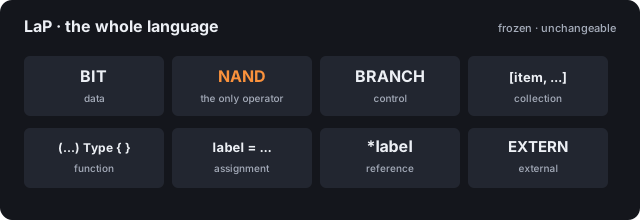
Eight primitives
The whole language:
BIT: the data primitive. A single bit, starting in an arbitrary state.NAND: the operation primitive. The only operator.BRANCH: the branching primitive. Pick a block based on a bit.[item, ...]: the collection primitive. An ordered list of mixed values.(params) Type { ... }: the function definition primitive.label = ...: the assignment primitive. Copy a value into storage.*label: the reference primitive. Alias existing storage.EXTERN: the external primitive. Memory, I/O, and the outside world.
No keywords. No built-in numbers or strings. No operators beyond NAND. A small surface area is what makes the spec freezable in the first place. There is nothing left to add.
One operator, everything else
NAND(a, b) is functionally complete. Every other logical operation is derived from it:
not a = NAND(a, a)a and b = NAND(NAND(a, b), NAND(a, b))a or b = NAND(NAND(a, a), NAND(b, b))a xor b = NAND(NAND(a, NAND(a, b)), NAND(b, NAND(a, b)))
Even ZERO and ONE have to be derived, because bits start in an arbitrary state:
flowchart LR
    A["seed: BIT (arbitrary)"] --> B["NAND(seed, NAND(seed, seed))"]
    B --> C["ONE"]
    C --> D["NAND(ONE, ONE)"]
    D --> E["ZERO"]
    E --> F["not, and, or, xor"]
    F --> G["All programs"]
One operator means there is nothing to extend, deprecate, or replace. The logic layer is done.
The rules
A few design rules keep the spec stable:
- No keywords. Identifiers are infix-separated.
- Nominal types. Identical layouts, different names, different types.
- Stack-only references. Take them, mutate through them, never return them.
EXTERNfor everything outside the language. The spec says nothing about what operations exist.
Try it
xor = (a: BIT, b: BIT) BIT {
    n = NAND(a, b)
    NAND(NAND(a, n), NAND(b, n))
}

main = () BIT {
    seed = BIT
    xor(seed, NAND(seed, seed))
}
XOR from four NANDs. main always returns ONE.