coslcs
Find matching bytes faster, without finding every possible match.
Two files can share bytes in the same order, even with gaps between them. An exact longest common subsequence algorithm finds the largest such sequence. coslcs finds a shorter one, trading completeness for speed.
Use it when a quick, approximate alignment is enough.
Take the nearest match
Closest Offset Sum describes the rule: choose the matching byte pair with the smallest combined distance from the current positions, emit it, and move forward.
Equal leading bytes match immediately. Otherwise, a small byte lookup table replaces pairwise comparisons. The source scan stops when later candidates cannot improve the best match.
No backtracking. No heap allocations in the Zig iterator.
What gets left behind
A nearby match can block a better result:
z wins on immediate distance, but consumes the end of the target. The remaining letters never get a chance.
The result is valid, not necessarily optimal. Identical inputs take linear time, while worst-case runtime remains quadratic for equal-length inputs. The fallback table occupies 2 KiB with 64-bit indices.
About the performance figures
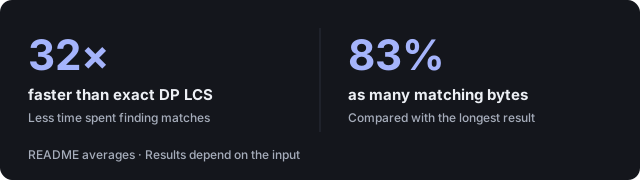
The chart shows averages reported in the README, not guaranteed speed or result quality. The included benchmark measures iterator speed only. It contains neither a dynamic-programming baseline nor an optimal-length comparison, so it cannot independently reproduce those figures.Try it
const coslcs = @import("coslcs");

var iterator = coslcs.CosLcsIterator.init("abc", "axbc");

while (iterator.nextPair()) |pair| {
    // pair.value
    // pair.source_index
    // pair.target_index
}
Use next() for bytes only and reset() to restart. Inputs are borrowed, not copied.
A C API is included. Its constructor allocates the iterator; iteration itself performs no heap allocations.
Requires Zig 0.16.0. MIT-licensed.